
Everhot Cookers offer supreme energy efficiency with up to half the running costs of comparable heat storage range cookers
Announced today, Wednesday 24th January 2024, Everhot is pleased that the Advertising Standards Authority (ASA) has upheld our complaint made against Aga, after the competing range cooker manufacturer made claims about its own energy efficiency.
Guy Goring, owner of Everhot Cookers, said: “We are delighted that the ASA has upheld our complaint against Aga’s energy efficiency claims. Everhot Cookers offer supreme energy efficiency. A fact we have always stuck by because of its importance to us as a British built range cooker manufacturer.
“Each Everhot cooker is hand built in our carbon negative factory here in the Cotswolds. As a family run business, we remain committed to the environment. With a desire to conserve energy being at the heart of the philosophy of our business and our cookers since it inspired the invention of the first ever Everhot over 40 years ago.
“Our unique trickle feed design, which enables our cookers to be simply plugged into 13amp sockets, means we continually strive to ensure our range cookers are as energy efficient as possible for our owners. Sustainability remains deeply embedded in our DNA and we never stop innovating to improve our cookers’ efficiency.”
Everhot’s complaint and the ASA’s ruling
Back in 2023, Everhot challenged a claim made on Aga’s website at the same which stated that its eR7 cooker had: “the lowest running costs for any heat-storage cast-iron range cooker”. We spoke directly to the ASA due to the fact that we regularly test and publish the energy consumption of our cookers to keep our customers informed.
The ASA has today ruled that Aga’s claim was based on the cooker being turned off and on. The ASA believes, as Everhot agrees, this is not consistent with the marketing of a heat storage range cooker – which is designed not just as an always on cooking appliance, but also to provide warmth to the kitchen. As the ASA mentioned: “The ASA understood that the purpose of heat-storage range cookers differed from a standard oven, and that they were designed to store and distribute heat in a way so that they could be left on all the time”.
Everhot has consistently, clearly, and simply displayed its complete running costs for all of our cookers being left on 24/7, using our overnight ECO function, on our website. Including the Everhot 110i model which is most closely comparable to the Aga eR7 – with three ovens, a hot plate and a simmer plate, and the addition of a two-zone induction hob as well. The Aga eR7 costs £17,735. Whereas the Everhot 110 costs £12,200 including VAT.

As the ASA ruled: “We next evaluated the running costs for both range cookers with all oven and hotplates having been left on continuously for seven days. The data showed that the AGA eR7 used 252kWh, whereas the Everhot 110i model used 116.41kWh. Whilst we acknowledged that was not necessarily reflective of typical consumer use, and that it was unlikely the hot plates would be left on continuously for seven days, we considered it was indicative of the running costs across all functions of the two cookers.
“Because the data showed that the Everhot model used significantly less energy over a seven-day period than the AGA eR7, we considered that demonstrated the AGA eR7 was the less energy efficient appliance based on continuous use of all functions.”
The ASA confirmed that, even though the Aga eR7 could be turned off and on as desired, potential customers would interpret a heat storage range cooker as being always on. Therefore, describing the eR7 as offering “the lowest running costs for any heat-storage cast-iron range cooker” would leave customers to assume that this was a fact based on the cooker being left on all the time.
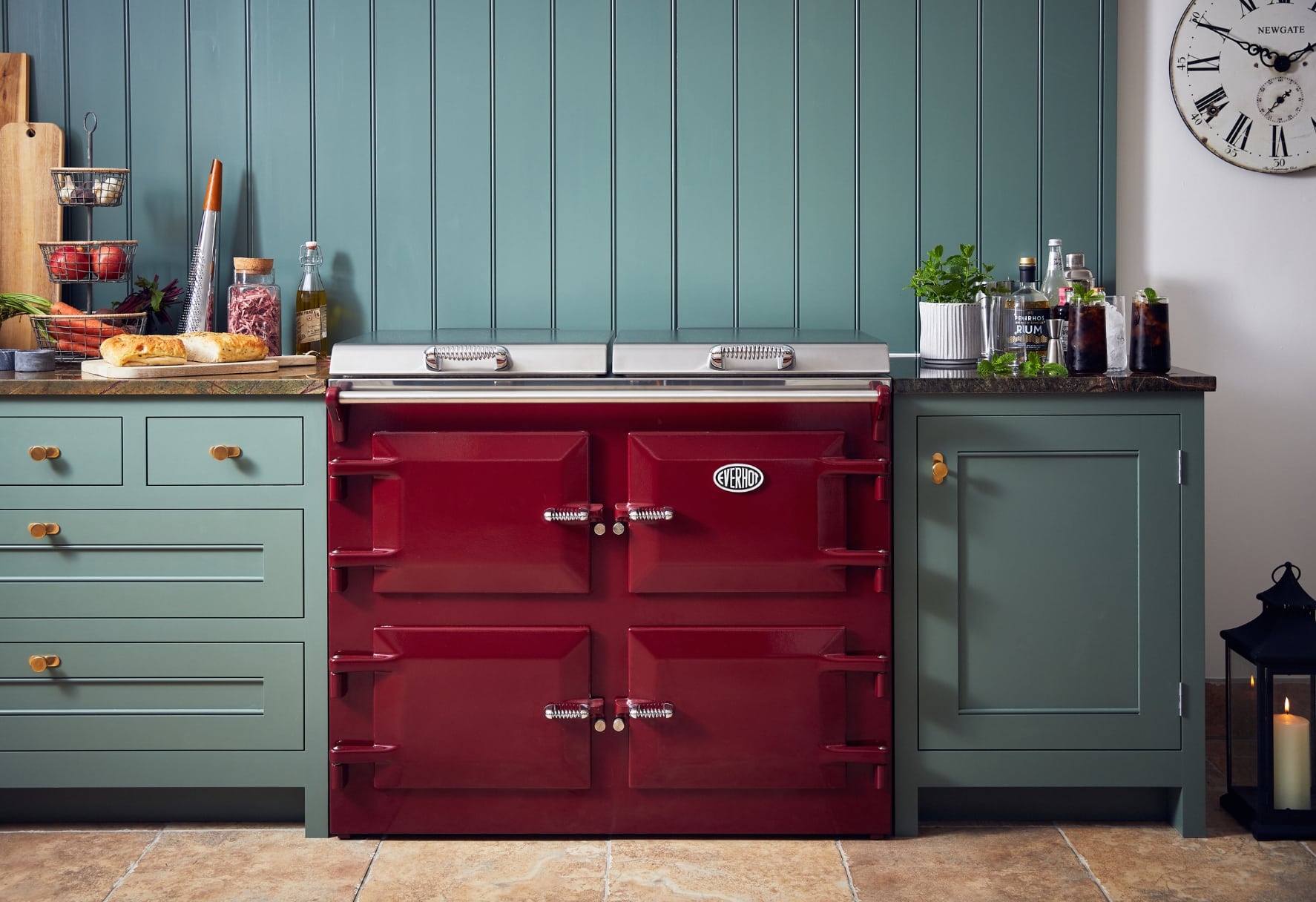
Whilst we have always known that Everhot cookers offer supreme energy efficiency, there are even more ways in which our customers and owners can make their cooker as efficient as possible:
Everhot’s ECO function
Everhot’s ECO function automatically drops the cooker into half temperatures overnight – from 9pm until 6am in the morning. This is a time when customers need the cooker and its warmth less, and they can therefore save money and electricity during this time. The actual timings themselves can be changed to whatever suits your lifestyle and can be set individually for each day of the week to fit in with your lifestyle.
Everhot’s oven delay function
As per our factory settings, once an Everhot comes out of its ECO function at 6am in the morning, it allows another three hours before fully heating up the ovens. This is because most of our owners will not need their ovens up to full temperature until lunchtime. However, they can also make further savings by delaying this heat up function even further. So, should you be out of the house during the day, and not needing your ovens until the evening, you can delay the heat up of the ovens by up to 12 hours. Again you can set this timing dependent on the day of the week. So you can still have a hot oven for Sunday breakfast even if you’re out the house for the working week.
Turning your Everhot ovens off
An Everhot offers incredible flexibility and our bottom ovens can be turned off for longer periods of time, for example should you go on holiday for a while. Whilst we never recommend turning the top ovens off, they also can be dropped as low as 50 degrees without problems when you’re not in the house.
Range cookers with induction hobs
Each of our cooker models, apart from the smallest Everhot 60, can be offered with the addition of an induction hob. Many of our owners find this to be useful during the summer months, when they prefer to turn down the temperature of their hot and simmer plate to reduce the amount of warmth in the kitchen.
Running an Everhot from solar panels
Finally, an Everhot is designed to run incredibly well with solar panels. If you have solar panels on your roof or are considering installing them, Everhot is the brand of range cooker you should choose. The automatic ECO function can be timed to coincide with the sun coming up and then setting in the evening. With the maximum peak consumption of an Everhot typically 2.85kW (the average is usually around 800W) it remains well below the capability of an average residential solar system.
You can read more about running an Everhot from solar panels in our blog here.
Discover the Everhot 110i here.
